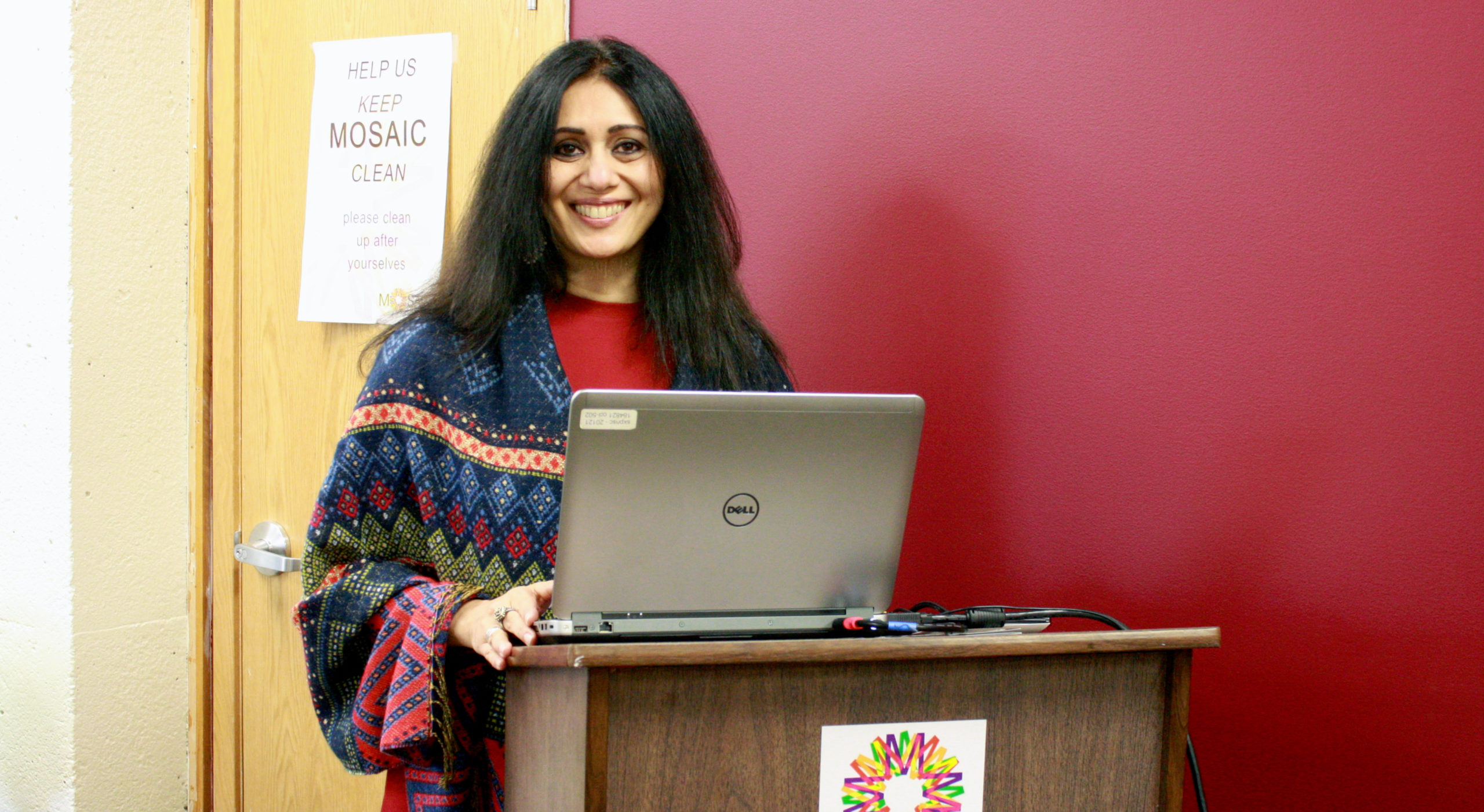

Filmmaker Mara Ahmed has scheduled the Rochester debut of her latest work, “The Injured Body: A Film About Racism in America” for May 30, 11:30 a.m. at the Little Theater.
The screening will be followed by a discussion between Ahmed and Jackie McGriff, a Rochester-based photographer and documentary filmmaker.
“The Injured Body” tackles the subject of microaggression, which Ahmed defines as “slights, slips of the tongue, and offenses that accumulate over a lifetime and impede a person’s ability to function and thrive in the world.” Microaggressions, the film reveals, can be as unsettling as a disrespectful comment or as deadly as having pain symptoms ignored by doctors.
I was fortunate to witness some of the early filming for “The Injured Body” for a 2018 article I wrote for the Rochester Beacon. After last week previewing the completed film, I am struck by how elements I witnessed in early creation cohere within a mosaic of intimate conversation and expressive arts.
“The Injured Body” includes the contributions of 16 activist Rochester women of color; 10 dance artists and choreographers; cinematographer Rajesh Barnabas; dancer and choreographer Mariko Yamada; portrait photographer Erica Jae; sound engineer Darien Lamen; and others.
Ahmed, who moved to Rochester with her husband and two children in 2003 and lived here 17 years, shared with the Beacon some thoughts about her intention and process:
ROCHESTER BEACON: I think what you’re doing, both through the interviews and the art forms, is encompassing the range of human experience that can’t be reduced to opposites or even just to language. The women are vulnerable and resilient. Brave and sometimes intimidated. Wounded and joyful. The film is far more than a litany of grievance and harm. In your view, what is “The Injured Body” about?
MARA AHMED: What a beautifully worded question, Cathy. Thank you for such a deep understanding of the film. It’s a rich tapestry of human experiences shaped by hegemonic systems such as racial capitalism and imperial power. This political context is critical—it’s where the body of color, the colonized body, the undocumented, incarcerated, objectified, dehumanized, and occupied body live. The film dwells in this reality, under these pressures, where language wounds and microaggressions accumulate over entire lifetimes, but also where the body becomes a powerful site of resistance and healing. The film tries to make the point that pain is never isolated. In my TEDx talk from 2017 titled “The Edges that Blur,” I quote Adrienne Rich and discuss how the body’s pain is linked to the pain on the streets. In my art practice, I am constantly attempting to connect the intimate to broader political structures.
ROCHESTER BEACON: How are the film’s structure and sensory richness—weaving together dialogue, music, dance, and lush photography—essential, both to convey meaning and to give audiences the neural ability to take it in?
AHMED: I love what you say about the neural ability to take it in, to process the testimonies shared in the film. Flow, rhythm, color, and texture are essential elements of “The Injured Body’s” architecture. The documentary is built around testimony, silence, music, movement, landscape, and seasonal cycles.
Human experience is vaster than the limits of straightforward language. Language alone cannot contain what the film is exploring: racial microaggressions, constant vigilance, embodied stress but also solidarity, strength, and joy. This is why dance is woven into the speaking.
The film’s nonlinear, sensorial structure also gives audiences the ability to absorb challenging material without shutting down. As we worked on choreography, Mariko Yamada and I talked a lot about Frantz Fanon’s work—how the oppressed body is perpetually flexed, contracted, unable to relax or breathe fully.
The dance sequences and visual interludes provide some breathing space to viewers, allowing them to work through their feelings. These alternate shifts between tension and release as well as speech and embodiment mirror how human beings process trauma, not only cognitively, but also somatically and emotionally.
ROCHESTER BEACON: What would you like audiences to take away from this film?
AHMED: With all my films, I hope to push people out of their comfort zones and make them question their pieties or that which they take for granted. I think of the French verb basculer: to topple, tip over, lose balance. This is the goal.
When I told many of my white friends I was making a film about microaggressions, most of them didn’t know what that word meant. I hope to follow Claudia Rankine’s example in “Citizen: An American Lyric” (a stunning book of poetry that endeavors to create the language needed to talk about microaggressions) and devise an equally effective cinematic language.
The film is also for people of color, for those who live on the margins. I am deeply invested in centering them, giving them the platform they need to speak freely and be heard with the attention and respect they deserve. I want to create a world where they are the default voices.
A professor friend saw my last film, “Return to Sender,” and said I had inverted the concept of double consciousness such that white people watching the film would become aware of how people of color view them—they too would feel a psychological “twoness.” I couldn’t ask for anything more.
ROCHESTER BEACON: Are you working on or planning a new project? If so, what?
AHMED: In 2023, I came across neuroscientist Antonio Damasio’s theory which expands on the mind-body connection and mentions “phantom limbs,” sensations (from tingling to severe pain) felt in body parts that are missing or amputated. This is because the brain maintains an internal map of the body. Even after a limb is amputated, the neural pathways that once carried signals between that limb and the brain can remain active. I couldn’t stop thinking about it. When UNRWA (United Nations Relief and Works Agency for Palestine Refugees)and other rights organizations reported that Gaza holds the record for the highest number of child amputees per capita in the world and that 10 children per day have lost one or both legs in Gaza during the genocide, I knew that I had found my work. It will be a mix of artwork, performance, oral histories, and perhaps a short experimental film. I have already created two analog collages for this project.
“The Injured Body: A Film About Racism in America”
Saturday, May 30, 2026, 11:30 a.m.
Little Theatre 1 (240 East Ave.)
$23 public | $20 seniors and students with ID. Tickets available online in advance, at the box office during open hours, or at the door if any remain.
E.C. Salibian is a Rochester Beacon founding editor.
More here.